The Mystery of the Nativity – A Re-Assessment
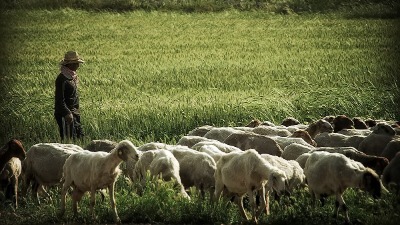 The Bethlehem shepherds were raising lambs for the temple. Jesus was born in a shepherd's tower called Migdal Eder. Shepherds swaddled lambs to keep them unblemished then placed them in a manger to keep them safe. What are we to make of these claims that have become increasingly popular in Christian circles in recent years?
The Life and Times of Jesus
Alfred Edersheim (1825 – 1889) was an Austrian Jewish convert to Christianity and a biblical scholar. He is known especially for his book The Life and Times of Jesus the Messiah (1883), which for decades was regarded as one of the best known and most important references on the life of Christ ever written.
In this work, the circumstances Edersheim depicts of Jesus’ birth in Bethlehem seem impressive. Furthermore, there are many websites that promote his ideas. Some elements, however, give cause for caution.
For example, the assertion that lambs born for Temple sacrifices were wrapped in ‘swaddling clothes’ for the sake of purity. The prime need of any new-born lamb is surely access to the mother’s colostrum in the first few hours, then her milk. Such isolation as swaddling would thus be harmful, and far too time-consuming for many lambs to be more-or-less simultaneously bottle-fed (if such feeding was then feasible). Thus, it seems that much closer scrutiny is required.
Bethlehem
But let’s start with the biblical geography of Bethlehem and Migdal Eder. Their earliest appearance is in the context of Jacob and Leah’s journey from Bethel to Ephrath (Genesis 35). In many translations, verse 16 tells us that Rachel went into labour a ‘little distance’ before Ephrath, although the Hebrew words are more accurately translated as ‘some distance’. A gloss in the 19th verse identifies ‘Ephrath’ as Bethlehem and some support for this is found in such verses as Ruth 1:2 and Micah 5:2 (e.g. ‘Bethlehem Ephrathah’).
Such isolation as swaddling would thus be harmful, and far too time-consuming for many lambs to be more-or-less simultaneously bottle-fed...
From the Hebrew meanings of Bethlehem and Ephrath1, it seems clear that the latter was the fertile (‘fruitful’) area in which the village of Bethlehem was situated, rather as ‘Bethlehem Judah’ situates the village in the tribal land of Judah (Ruth 1:1, 1 Sam.17:12). This is important, as it distinguishes it from another Bethlehem – the one in the tribal lands of Zebulon in southern Galilee (Joshua 15:18-19). The contextual detail in the book of Ruth testifies to the production of barley in the fields of Bethlehem Judah.
Migdal Eder
But was Migdal Eder (‘the tower of the flock’) associated with Bethlehem? Our first encounter with this tower is also within Jacob and Leah’s journey from Bethel. Having buried Rachel and setting up a memorial, Jacob continued southward, pitching his tent ‘beyond Migdal Eder’ (Gen.35:21). But where was Rachel buried? The Scriptures do not identify the place. The traditional site, visited by pilgrims of various faiths over centuries, lies about two-thirds of the 6 miles or so between Jerusalem and Bethlehem.
However, according to Strickert, “During the Roman and Byzantine era, when Christians dominated, there was really not much attention given to Rachel's Tomb in Bethlehem. It was only when the Muslims took control that the shrine became an important site.”2 Hence, so far, we have no biblically-secure specific location for Rachel’s burial and as yet neither for ‘the tower of the flock’, Migdal Eder.
What else can we learn from Scripture? In verses 7-8 of Micah 4 we read “…. So the LORD will reign over them in Mount Zion from now on even forever. And you, O tower of the flock [Migdal Eder], the stronghold of the daughter of Zion, to you it shall come, even ….. the kingdom of the daughter of Jerusalem”. And verse 7 of 2 Samuel 5 clearly states: ”Nevertheless, David captured the fortress of Zion (that is, the City of David)."
Biblically, Migdal Eder is securely associated with Jerusalem rather than with Bethlehem, as it also is in the Mishnah.
This event marks a pivotal moment in Israel's history, with David’s conquest of the Jebusite city establishing Jerusalem as his capital. In the Mishnah we find this: “If an animal that is fit for the altar was found straying, from Jerusalem and as far as Migdal Eder, and similarly if it was found within that distance from Jerusalem in any other direction, it is presumed that the animal came from Jerusalem.”3 Thus, biblically, Migdal Eder is securely associated with Jerusalem rather than with Bethlehem, as it also is in the Mishnah.
Furthermore, Edersheim’s association of Migdal Eder with the birth of Jesus depends on his attribution of that to Targum Pseudo-Jonathan on Genesis 35:21, which Targum actually reads: “And Jacob spread his tent beyond the tower of Eder, the place from whence, it is to be, the King Messiah will be revealed at the end of days. Plainly, the birth of Jesus doesn’t mark ‘the end of days’, and in any case, the Genesis text itself simply describes a fact of history, with no prophetic indication.
The manger
However, let’s get back to Bethlehem and the birth of Jesus. In the recent Issachar article ‘The Mystery of the Nativity’ it is stated that “We can assume that the manger was the birthing stall at Migdal Eder where the sheep born to be sacrificed at the Temple were born and raised. A similar statement is made by Cooper P. Adams III: “In fact the angels did not have to tell the shepherds precisely where to go in Bethlehem to find Jesus, because there was only one manger where sacrificial lambs were birthed, the cave under the watch tower of Migdal Eder.
Both these statements appear to be authoritative. Articles from this stance sometimes view the Greek word phatne, translated ‘manger’, as referring to a 'birthing stall'. However, according to Strong’s Concordance, G.5336, phatne is defined primarily as ‘a crib (for fodder)...’, deriving from the verb ‘πατέομαι patéomai (to eat)’.
Hence, there really is no justification to replace the meaning of ‘manger’.
Moreover, the Septuagint uses the same word for “feeding trough” in Isaiah 1:3; Job 39:9; Proverbs. 14:4. Primarily its function was for feeding. Greek words connected with ‘birth’ are quite dissimilar, namely:
-
apokueó – to give birth (STR G616 only used in James 1:15, 18 – ‘bring forth’)
-
gennao - to beget, generate (STR G1080)
-
tiktó - To bear, bring forth, give birth - as in Luke 2:2 (‘be delivered’), Matt.1:25; Luke 2:7 (‘brought forth’); Matt. 2:1 (‘has been born’) (STR G5088)
Hence, there really is no justification to replace the meaning of ‘manger’.
Sacrificial lambs
Returning to the subject of early care for lambs, on the UK advisory service website, we find this recommendation: “Avoid lambing ewes in small pens to keep bedding as clean and dry as possible. Any obvious wet straw and afterbirth should be cleaned out and fresh, clean straw provided between ewes to reduce mis-mothering and disease issues. …. Any lambs that do not feed within the first few hours after birth will soon run out of energy reserves to keep warm, and will die rapidly if there is no intervention; no matter what environment they are born into. This is surely the ‘nail in the coffin’ for the ‘swaddling’ theory! And that’s before we also think about the lambs’ outputs.
We need to be ultra-cautious in using the Talmud/Targums/Mishnah, given that they post-date the inspired Scriptures often by hundreds of years...
As for the claim that Bethlehem shepherds dedicated to produce sacrificial lambs, including Passover lambs, confirming my own researches, Chad Bird writes: “I have found no evidence in older Jewish literature—and certainly not in the Bible ….. (It) is wholly unsupported by evidence.” Furthermore, as Scholar-in-Residence at the Reformation Theology website ‘1517’, a former graduate student at Hebrew Union College, having read the Mishnah in Hebrew, states: “It is indeed valuable as later evidence that purports to preserve older oral traditions and teachings. That being said, the Mishnah cannot be used as reliable evidence for something that predates it by two hundred years.”
Heeding caution
What is the main lesson we can learn from this experience? Surely, that we need to be ultra-cautious in using the Talmud/Targums/Mishnah, given that they post-date the inspired Scriptures often by hundreds of years, having been mainly created in exile from the land of Israel in later centuries.
We should also bear in mind that already by the early first century, Jesus Himself asked the scribes and Pharisees of Jerusalem, “Why do you also transgress the commandments of God by your traditions.” (Matt.15:3).
Endnotes
-
Beth Lechem – ‘House of Bread’ (STR G1035); Ephrath – ‘fruitfulness’ (STR.G672)
-
Strickert, Frederick M. (2007). Rachel weeping: Jews, Christians, and Muslims at the Fortress Tomb. Liturgical Press
-
Mishnah Shekalim 7:4
David Longworth, 06/01/2026