Tim Dieppe reviews ‘Who Are You Really? A Philosopher’s Inquiry into the Nature and Origin of Persons’, by Joshua Rasmussen (2023)
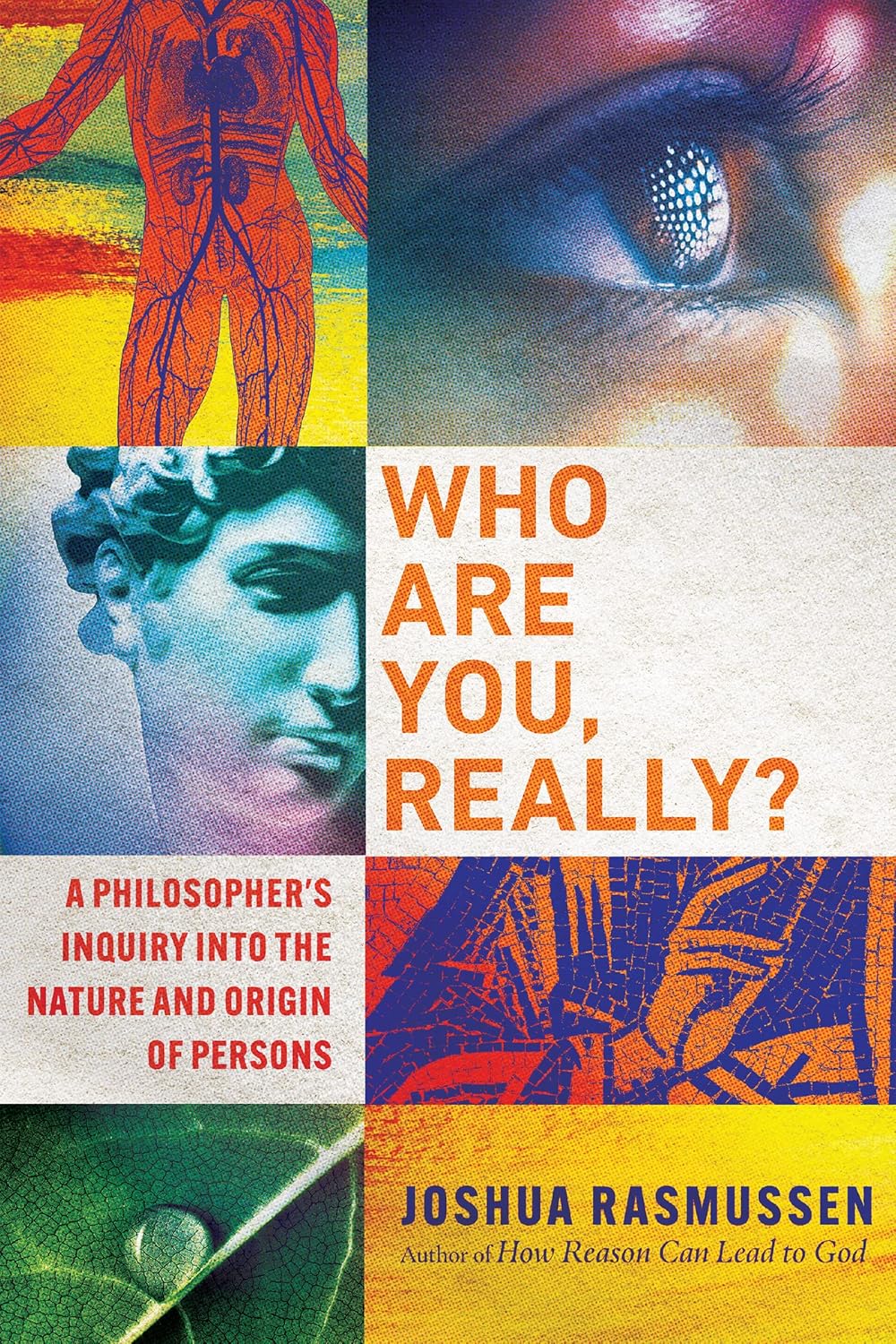 This is a most fascinating and original book. The author is a Christian philosopher. In this book, however, there is no appeal to the Bible or any other specifically Christian arguments.
Introspection and reason
Instead, Rasmussen appeals merely to introspection and reason to determine what we can learn about human nature and the origin of persons just by thinking about it and without special revelation.
The author defines introspection as the power or sense to be aware of something in consciousness by directing your attention inwards (p6). Just being mentally aware of reading these words is an example of introspection. He then argues that introspection is foundational to human knowledge.
He points out that attempts to deny that introspection gives us reliable knowledge are self-defeating. If you had no introspection, then you couldn’t even assess an argument to doubt introspection. If you reason that introspection is unreliable then you must have used introspection to reach that conclusion! A scientific argument arguing that introspection is never reliable is self-defeating since the author must have used introspection to construct the argument.
It makes no sense to reason that we cannot rely on reason!
The same kind of argument applies to reason. It makes no sense to reason that we cannot rely on reason! With these two foundational tools of introspection and reason, the author invites us to consider what it means to be conscious beings.
Conscious beings
In part one of the book, the author considers “the nature of you”. First up is our feelings. What makes us able to feel? How can a collection of atoms feel something? Could a feeling being be constructed out of grains of sand – however complexly arranged? It doesn’t seem that consciousness can just emerge out of ordinary matter. This he calls “the construction challenge” (p21).
Furthermore, we can’t really deny that some things have consciousness since such a denial would be self-defeating (p27). Even thinking that there might be no mental states is itself a mental state! Therefore, we know for certain, consciousness is real.
The next chapter considers your thoughts. The question is, do thoughts correspond to material states in the brain? A simple thought experiment shows that we can construct more possible thoughts than possible spatial links in your brain (pp62-4). This means that brain states alone cannot account for all our thoughts. So, what does?
We know intuitively that we are morally responsible for our choices. Our will, therefore, cannot be deterministic.
Further chapters consider your sight, your will, your value, your body, and your self. How is it, for example, that you have free will? Your free will requires you to be more than the particles that make up your body – otherwise your actions are merely determined by particle interactions. But we know by introspection that we do have free will. We know intuitively that we are morally responsible for our choices. Our will, therefore, cannot be deterministic. We must be more than mere matter.
The origin of you
An initial chapter considers the construction problem in more detail. How can you construct consciousness from matter? Many arguments lead to the conclusion that this simply cannot be done.
Another chapter looks at the identify problem. What makes you you? What makes you the same person as the baby that came out of your mother’s womb? It can’t be the atoms in your body as these are continually changing. Imagine a sci-fi world in which you could travel to another planet by taking a molecular map of every atom of your body, destroying your body on earth, and then reassembling your body exactly as it is today on the planet Zorg. Would it then actually be ‘you’ on the planet Zorg? Would you volunteer to be transported to the planet Zorg in this way?
Mental universe
Towards the end of the book, the author argues that consciousness can only come from a conscious-making substance. The conclusion, then, is that you must have emerged from a fundamental first-person substance. From this conclusion, Rasmusen argues that mind is more fundamental than matter. This aligns with the views of Nobel Prize winning physicist Max Plank who said: “I regard matter as derivative of consciousness.” (p256). Another physicist too has concluded: “The universe is mental.”
If you cannot be constructed from matter, then matter cannot destroy you. You will continue to exist no matter what happens to the matter comprising your body!
From here, Rasmussen proposes “the informational theory of matter”. This view makes sense of the primacy of consciousness. It also explains the Relational Quantum Mechanics whereby some physical systems are relative to the observer. The conclusion, therefore, is that matter is fundamentally mindful. Or, as Rasmussen puts it, “Personal reality is the primary reality.” (p271)
Christian worldview
In a final move, Rasmussen switches the construction argument around to think about how you could be destroyed? In short, if you cannot be constructed from matter, then matter cannot destroy you. You will continue to exist no matter what happens to the matter comprising your body!
The author doesn’t make the next move to argue that there is therefore a personal conscious God who is the source of all being. This book very deliberately avoids being explicitly Christian.
Nevertheless, these arguments are strong defeaters for atheism, and the conclusions tie in neatly with a Christian worldview. Hopefully this review will have left you interested to read the book for yourself. I loved it, and it comes highly recommended.
Who Are You Really? is published by IVP and is available on Amazon for £17.
Tim Dieppe, 23/01/2026