Scotland’s Forgotten Martyrs
Receiving inspiration from the lives and witness of the Scottish Covenanters
 The author of the Epistle to the Hebrews knew that suffering Christians needed exemplars—heroes, we might say—to inspire them to hold fast their faith in time of trial. Of course, the great Hero of the book of Hebrews, and of Scripture as a whole, is the Lord Jesus Christ.
Christian biography
While we hold firmly to Christ’s supremacy in every area, including as our great example in the life of faith, the Lord, in his kindness, has also supplied us with ‘heroes of the faith’ who are flawed like us. Some of them are found in the so-called ‘Hall of Faith’ in Hebrews 11. There we find a Scriptural example of the use of what might be called ‘Christian biography’ to elicit and encourage similar kinds of faith in the hearer.
Christian biography carries power to instruct, to warn, and to inspire faith in the Lord Jesus Christ. In particular, telling the stories of Christian witnesses who were also martyrs (the Greek mártyrs means ‘witness’) can help prepare the Church to be ready for times of difficulty. Sadly, many of us have very little awareness of our spiritual heritage—of Christian biography in general and Christian martyrology in particular.
The Case of the Covenanters
The Scottish Covenanters were men and women who believed in the gospel as it was recovered at the Reformation and who wanted to worship the Lord without the accoutrements and man-made traditions that they saw in both the Roman Catholic and Anglican systems. When the Stuart kings tried to interfere with the running of the Scottish Kirk, imposing bishops and the English Prayer Book, the Covenanters banded together to draft and sign an undertaking with God - the National Covenant of 1638 - in which they committed to uphold the Scottish Reformation and oppose both Popery (Roman Catholicism) and Prelacy (the system of royally-controlled bishops).
It was this clear understanding of the God-ordained limitations of the king’s power that would get them into so much trouble with the Stuart state.
The Covenant showed respect for the authority of the king when that authority was confined to its proper sphere. But the Covenanters held that while Charles I was the God-appointed head of the state, he was merely a member of the Kirk and had no authority to impose his, or anyone else’s, will on the Church of Christ. It was this clear understanding of the God-ordained limitations of the king’s power that would get them into so much trouble with the Stuart state.
When I moved up to Scotland from England to work for the Banner of Truth (a Reformed Christian ministry founded in London in 1957 and based since 1972 in Edinburgh), I had a very inadequate understanding of the seventeenth-century Covenanters. I had encountered them in the historian Neil Oliver’s 2008 television documentary series The History of Scotland. His portrayal, however, was generally negative: he saw them as religious zealots, carrying their devotion to fanatical extremes.1
Upon assuming my duties in Edinburgh, I began to read a very different perspective on the Covenanters, in J. K. Hewison’s two-volume The Covenanters (first published in 1908, Banner of Truth edition 2019). Hewison was a Victorian historian of considerable learning who painstakingly documented the rise and progress of the Covenanting movement. While this scholarly work is limited in its devotional value, Hewison deals robustly both with those who suggest that the Covenanters were just religious fanatics on the one hand or early martyrs for democracy on the other.
No, Hewison accepts the Covenanters on their own terms, and their terms were an all-encompassing desire for Christ to be honoured in the Church and state. For this they were willing to suffer the loss of their livelihoods, liberty and even life itself.
For this they were willing to suffer the loss of their livelihoods, liberty and even life itself.
A Fresh Angle
In an effort to ‘unblock’ the wells of Covenanting history for God’s people today, I recently helped in the production of a four-part documentary mini-series. The videos (which can be watched for free here) tell the stories of four men whose martyrdoms shed light on different stages of the Covenanter struggle: James Guthrie (d. 1661), Hugh M‘Kail (d. 1666), John Brown (d. 1685), and James Renwick (d. 1688). ]
John Brown was the only one of the four who was not a church minister. He was poor, eking out a living in the boggy, windswept hills of Ayrshire, in south-west Scotland. Despite his straightened circumstances, he loved the Lord and convened a sort of rural school of theology, meeting with young men eager to know God’s word, out in the sheepfolds in the summer and in his little cottage kitchen in the winter.
Like most Covenanters in Scotland in the 1680s, he lived under constant threat of being discovered and questioned by government agents. Not only that, but Brown’s death had already been prophesied by Alexander Peden (1626-86), the travelling preacher. Jock Purves relates the circumstances:
“[Peden] had married the Covenanter to Isabel Weir in 1682, and after the simple Puritan ceremony had said to Isabel, ‘Ye have a good man to be your husband, but ye will not enjoy him long; prize his company, and keep linen by you to be his winding sheet, for ye will need it when ye are not looking for it, and it will be a bloody one.’ A Covenanting wedding! The Covenanter’s deepest joys ever carried the shadow of the Cross.”2
Brown’s death had already been prophesied by Alexander Peden (1626-86), the travelling preacher.
Peden’s prophecy was fulfilled on the morning of May 1, 1685. John Brown had left his hillside cottage early to dig peat for fuel out on the moor. En route he came across three troops of Dragoons led by the notorious John Graham of Claverhouse. Claverhouse had been tasked with hunting down the itinerant preachers who held outdoor meetings (‘conventicles’) and he arrested Brown on the spot.
Taking him back to his cottage, he searched the place and, finding evidence that Brown was a Covenanter, commanded him ‘go to your prayers, for you shall immediately die.’ In front of his cottage, in full view of his young wife Isabel who was heavy with child, John Brown was gunned down. Isabel was left to gather up the scattered brains of her husband and mourn a faithful man who lived in evil days.
Faithful witnesses
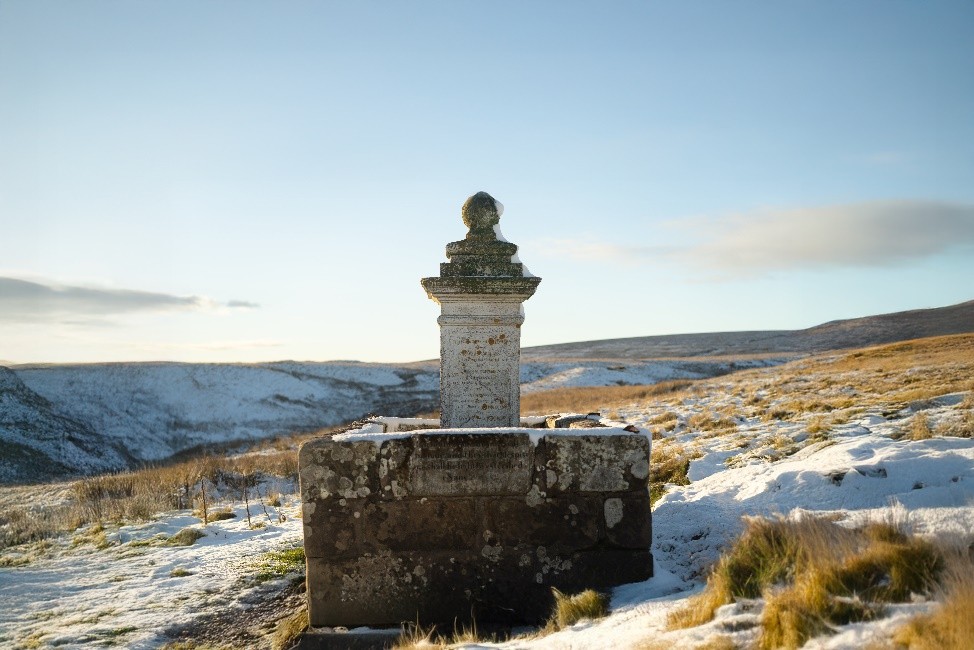
In the course of filming these four short videos, no location was more poignant than the bare, still-remote hillside where John Brown’s cottage is presumed to have stood, and where his memorial now stands.
I do not doubt that one day this lowly servant of the Lord Jesus and his devastated wife will receive high honours in the kingdom. I am persuaded, too, that their testimonies are much needed by the Church in the UK today. For, as Paul reminded Timothy, ‘all who desire to live a godly life in Christ Jesus will be persecuted’ (2 Timothy 3:12).
I do not doubt that one day this lowly servant of the Lord Jesus and his devastated wife will receive high honours in the kingdom.
One final note may be of particular interest to readers of Prophecy Today. There is evidence that even as the Covenanters were pursued across muir and mountain, suffering great privations of body and soul, they made efforts to keep the people of Israel in mind and pray for them. In 1679, Covenanter Walter Smith, who would later be martyred, wrote guidelines for the prayer meetings of the ‘remnant’ of the Scottish Kirk. He expressed his desire ‘that the old offcasten Israel for unbelief would never be forgotten, especially in these meetings, that the promised day of their ingrafting again by faith may be hastened…’
Why not watch The Covenanter Story? I trust you will be informed and encouraged by the testimonies of these four saints (and there were many others) who resemble so closely the faithful witnesses of Hebrews 11:
“They went about in skins of sheep and goats, destitute, afflicted, mistreated— of whom the world was not worthy—wandering about in deserts and mountains, and in dens and caves of the earth.” (Heb. 11:37-38).
Endnotes
-
It should be noted that since the production of A History of Scotland, Oliver seems to have adopted a mellower tone towards the Covenanters, although he still regards them as ‘religious extremists.’ For a recent contribution from him on the topic, see episode 52 of his ‘Love Letter to the British Isles’ podcast:
-
Jock Purves, Fair Sunshine: Character Studies of the Scottish Covenanters (Edinburgh: Banner of Truth, 2003), page 52.
Joshua Kellard is Communications Manager for The Banner of Truth Trust
(top image - John Brown's memorial stone in Muirkirk is still remote today)
Joshua Kellard, 19/03/2026