Yesterday’s Encounter Cannot Replace Today’s Surrender
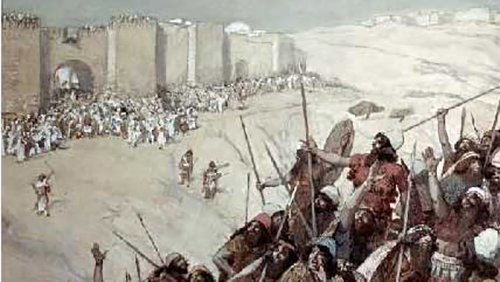 There is something deeply sobering about the way Joshua 7 follows the extraordinary victory at Jericho. Israel has just watched walls fall before them, leaving absolutely no question about where their victory had come from. There was no brilliant military strategy to take credit for, just some very strange instructions involving marching, trumpets and shouting, followed by an impossible victory that only God could have given them.
Ai Ai
Then they arrive at Ai, and everything feels different.
Compared with Jericho, Ai looks easy. The spies tell Joshua there is no need to send the whole army because two or three thousand men should be enough, and I can’t help thinking we are meant to notice the contrast. Jericho was impossible, so Israel knew they needed God; Ai looked manageable, and almost immediately there seems to be a subtle shift from dependence towards self-confidence.
I find that uncomfortably relatable because it is often the things we know we cannot do that keep us closest to God, while the things we think we can handle are where dependence can quietly begin to slip. We pray differently when we know that unless God moves, nothing will happen, but after seeing Him move powerfully it is remarkably easy to carry the confidence of yesterday’s victory into today’s battle and forget where that victory came from.
Yet before Israel even reaches Ai, Scripture has already told us something Joshua doesn’t know. There is a problem hidden within the camp.
Achan’s actions
Achan has taken some of the things from Jericho that were devoted to God and buried them beneath his tent. Outwardly, everything still looks as it should. Jericho has fallen, Israel is advancing and there is every reason to expect another victory, but underneath that apparent success something has changed.
Ai looked manageable, and almost immediately there seems to be a subtle shift from dependence towards self-confidence.
To understand why Achan’s actions matter so much, we have to remember what Jericho represented. Israel had been specifically commanded not to take its spoils for themselves. The silver and gold belonged to the Lord’s treasury, while everything else had been placed under the ban. Jericho was the first city conquered after Israel crossed the Jordan, and I think there is a beautiful firstfruits principle within that: before Israel began enjoying the inheritance God had promised, the first victory was surrendered completely to Him.
Achan knew that, yet looked at something consecrated to God and decided to keep part of it for himself.
His confession later in the chapter is incredibly revealing: “I saw… I coveted… I took.” As soon as I read those words, I was taken straight back to Eden. Eve saw that the fruit was desirable, desired what God had forbidden and took it. We see the same pattern again with David and Bathsheba, and James later describes exactly this process when he tells us that desire, once conceived, gives birth to sin. The circumstances change, but the pattern is remarkably familiar: we see, desire becomes disordered, we take what was never ours to take, and then we try to hide it.
Achan buries everything beneath his tent, and there is something about that detail that really stayed with me. Publicly, he is still standing among God’s covenant people, while privately something God has forbidden is hidden beneath his household. Nobody else knows it is there, but God does, and it made me think about how easily we can reduce holiness to what is visible. We can look right, say the right things and stand among God’s people while still keeping areas of our lives carefully buried where nobody else can see them. Yet God has never been interested only in the version of us that other people see. He deals with what is beneath the tent.
Stop praying
Israel goes into battle at Ai expecting another victory and instead suffers a devastating defeat. Thirty-six men die, and Joshua is broken. He tears his clothes, falls facedown before the Ark and begins asking God why He ever brought Israel across the Jordan if this was going to happen.
God has never been interested only in the version of us that other people see. He deals with what is beneath the tent.
Then comes one of the most striking moments in the chapter. God tells him, “Stand up! What are you doing down on your face?”
Joshua is doing something that looks entirely spiritual. He is facedown before God, praying and grieving, yet God tells him to get up because this isn’t a situation that requires more prayer. Something He has already spoken about has been disobeyed, and now it needs dealing with.
That challenged me because there is a time for prayer, but prayer can never become a substitute for obedience. We can ask God for breakthrough while quietly tolerating something He has already asked us to surrender. Or, keep asking Him why something isn’t changing when His Spirit has already been putting His finger on the thing that needs to change in us. Sometimes the spiritual response isn’t another prayer meeting. Sometimes it is repentance.
Corporate Christianity
Joshua is asking where God is, but God turns his attention back towards the camp: “Israel has sinned; they have violated my covenant.”
That language can feel difficult because it was Achan who took the devoted things, yet God speaks about Israel. Biblical covenant thinking is far more corporate than the individual way we tend to think today. Israel was not simply a collection of people who happened to believe the same things; they were one covenant people carrying the presence of God together, and what one person concealed had consequences that reached far beyond himself.
The New Testament doesn’t remove that principle. Paul tells the Church that a little yeast works through the whole batch and that when one part of the body suffers, every part suffers with it. That doesn’t mean we indiscriminately carry another person’s guilt, but it does mean we should take seriously something our culture often doesn’t: our choices rarely affect only us. Sin has ripples, and thankfully, so does holiness.
We should take seriously something our culture often doesn’t: our choices rarely affect only us.
Sin in the camp
This matters even more when we remember what Israel is actually doing in Joshua. They aren’t simply taking territory. They are carrying Yahweh’s covenant presence into the land He has promised them, with the Ark among them and holiness at the centre of what it means to be His people. The problem at Ai was never that God had somehow become less powerful after Jericho. The problem was that Israel could not treat His holy presence as though it were compatible with covenant rebellion.
It also challenged the way I think about spiritual warfare because we can become very focused on what is happening outside the camp, on opposition, principalities, powers and what the enemy might be doing, and Scripture absolutely tells us those realities exist. Yet Joshua 7 made me realise that Israel’s greatest threat at that moment wasn’t actually the enemy they could see in front of them, but the compromise they didn’t yet know had been allowed to remain within the camp.
Jericho couldn’t stop them, and Ai should never have stopped them, but concealed disobedience did.
It made me think again about the order James gives us: “Submit yourselves, then, to God. Resist the devil, and he will flee from you.” Submission comes first, which means sometimes the most important question in spiritual warfare isn’t only, ‘what is the enemy doing?’ We may also need to ask what we are agreeing with, what we are excusing, what we are keeping hidden and whether there is something that belongs wholly to God that we are still trying to keep for ourselves.
A door of hope
What happens next is severe, and I don’t think we should try to make it more comfortable than Scripture does. Achan’s sin is exposed and judgement comes in the Valley of Achor, the Valley of Trouble. Sin has entered sacred space and brought death with it, just as it did in Eden, reminding us that the holiness of God isn’t something His people get to redefine according to what feels acceptable to us.
The holiness of God isn’t something His people get to redefine according to what feels acceptable to us.
But the Valley of Achor doesn’t disappear from the biblical story.
Centuries later, when God speaks through Hosea about restoring His unfaithful people, He says something extraordinary: “I will make the Valley of Achor a door of hope.”
I love that because God doesn’t rewrite what happened there or pretend the rebellion didn’t matter. The Valley of Trouble really was a place of failure, exposure and judgement. Yet God was not prepared to let trouble have the final word over that place. In His hands, even a valley carrying the memory of failure could become a doorway into hope.
And ultimately, that takes us to Jesus.
Jesus comes
Achan’s confession exposes a pattern humanity has repeated since Eden: he saw, he desired and he took. Humanity keeps grasping for what God has not given us, trying to possess what belongs to Him or build life on our own terms, and then Christ comes and does something completely different. Philippians tells us that although He was in very nature God, He did not use equality with God for His own advantage, but emptied Himself and took the nature of a servant.
We needed cleansing that could reach what was buried beneath the surface, into the places nobody else sees, and that is exactly what Christ accomplished at the cross.
The contrast is extraordinary because where humanity has continually grasped for itself, Jesus gives Himself away, and where we have repeatedly broken faith with God, Christ remains perfectly faithful, even willingly taking upon Himself the judgement of those who were not.
That is why Joshua 7 points beyond Achan, because removing one man’s sin from the camp could never solve the deeper problem running through humanity. We needed cleansing that could reach what was buried beneath the surface, into the places nobody else sees, and that is exactly what Christ accomplished at the cross.
The chapter doesn’t end Israel’s story either. Once the sin has been brought into the light and dealt with, Joshua 8 begins with God saying, “Do not be afraid; do not be discouraged,” before sending them straight back to Ai, the very place where they had been defeated. Their failure was real and the consequences were real, but failure did not cancel God’s purpose for them.
Presence via surrender
Perhaps that is what has stayed with me most from Joshua 7. Israel had experienced the supernatural at Jericho, carried the promises of God and knew what His presence felt like, yet none of that made today’s obedience optional. Yesterday’s encounter with God could not replace today’s surrender to Him.
His presence is still far too precious for us to cling to anything He is asking us to lay down.
I don’t think the invitation in Joshua 7 is to become frightened that God is searching for something with which to condemn us, but to understand just how precious His presence really is and therefore why we cannot comfortably make peace with the things He is asking us to surrender. The God who brings what is hidden into the light is also the God who restores, who sends His people back to the place of their defeat and who can take even a Valley of Trouble and turn it into a door of hope.
Yesterday’s victory is a wonderful testimony, but it was never meant to become today’s dependence. God is still asking for our trust, our surrender and our obedience now, because the greatest thing Israel carried into the Promised Land was never their ability to win battles; it was the presence of the God who went with them.
Perhaps Joshua 7 leaves us with the uncomfortable but beautiful reminder that His presence is still far too precious for us to cling to anything He is asking us to lay down.
----------------------------
Hannah Damary-Thompson is Commercial Director at Specialist Wind Services, working across the UK’s onshore and offshore wind sector. She is a mother of four, attends Powerhouse Church in Doncaster, and is currently writing her first book, Diary of a Disciple.
Hannah Damary-Wilson, 02/09/2026