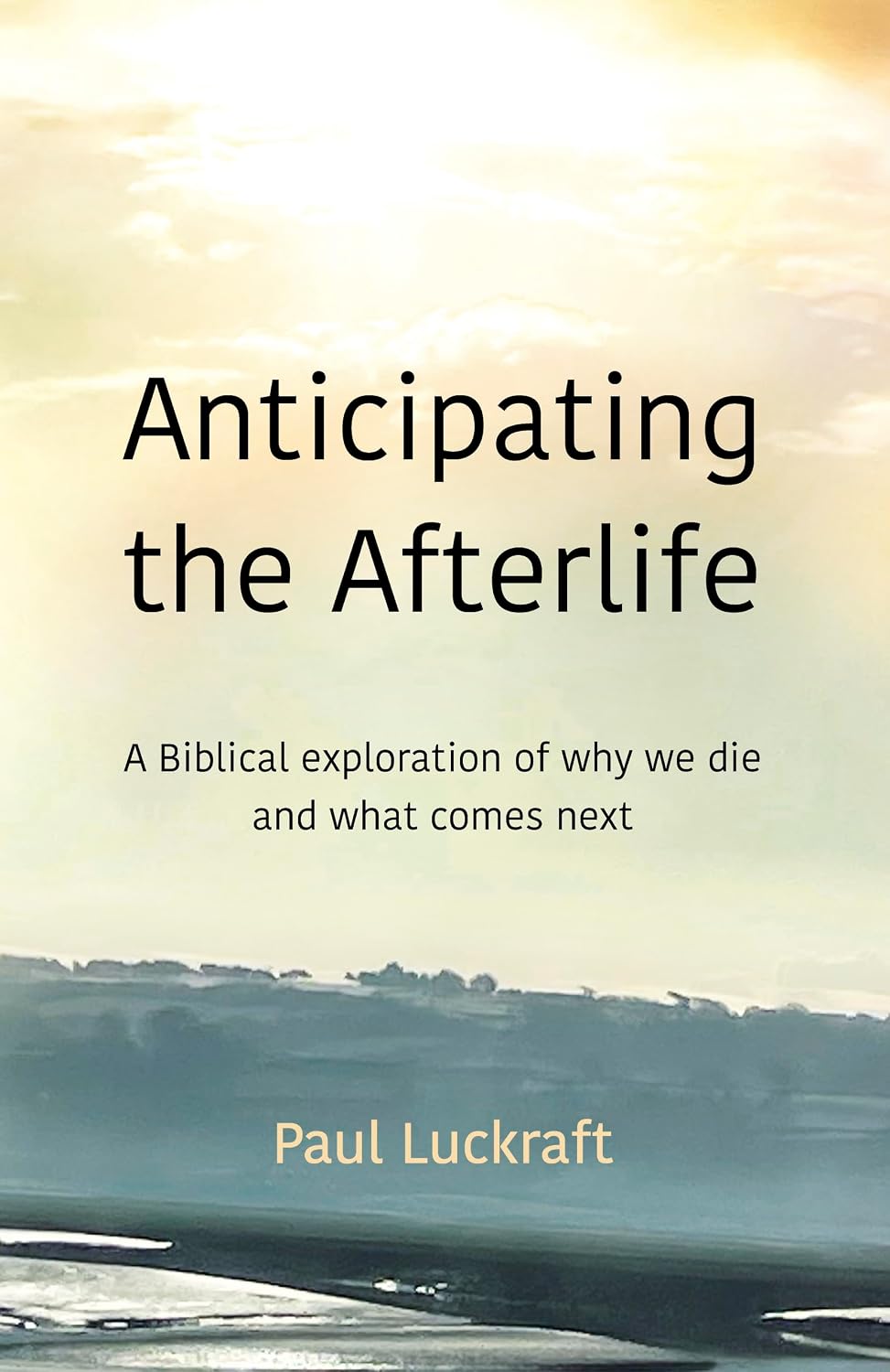
Anticipating the Afterlife
A Biblical exploration of death and what comes next
 Imagine you are sharing your faith with a neighbour, family member or work colleague. You have talked about God and Jesus, you have explained about sin and salvation, and you have even managed to get them interested in church. They are getting closer to making a commitment. Then they ask the big questions. What will happen to me when I die? What exactly is this heaven you Christians always talk about? You don’t seriously still believe in hell, do you?
How would you cope at this point? Do you have answers ready or might this be the moment when all your previous faithful witness starts to unravel? If you are unsure on these matters, how can others be confident your faith in the future has any real substance?
Belief in an afterlife
It was partly with this in mind that I chose to write a book about the afterlife, all the while being very much aware I would be tackling some of the most controversial and sensitive issues regarding human destiny, both for the individual as well as for humanity as a whole. It was not an easy task but hopefully the result has been worthwhile and will give believers more assurance in their own faith as well as being helpful in those awkward moments with those yet to believe.
Today’s society may be secular and materialistic, but surveys show that a sizeable proportion of the population, both in the UK and elsewhere, still believe in some kind of afterlife. Despite a decline in traditional religious belief, many retain a hope that this life is not all there is. But there are many different views on ‘what comes next’ and most are far from biblical, hence the subtitle of my book, ‘A biblical exploration of why we die and what comes next’.
Some claim we cannot know anything about the afterlife as no-one has experienced death and come back to tell us about it or what to expect afterwards. It is also argued that the limitations of human knowledge and scientific investigations are such that we would need special revelation if we are to see beyond the veil into the afterlife and this we do not have.
Surveys show that a sizeable proportion of the population, both in the UK and elsewhere, still believe in some kind of afterlife.
But Christians assert that the Bible contains that special revelation, or at least as much as we can reasonably expect. Indeed, the Bible is the only reliable source of truth regarding our future destiny, the ultimate means of settling the great questions of the afterlife. In particular, we have the fact of the resurrection of Jesus. Everything revolves around this. Here is the key question to challenge the unbeliever. Do you think Jesus is alive today? Their response to this is the starting point for further witness to the truth.
Emotive aspects
There were many aspects of the afterlife that had to be considered when writing this book. Some are very emotive, such as the death of babies and infants, and even what happens to your pets when they die. Is there an afterlife for animals, a sort of ‘doggy heaven’? Might you one day be reunited with your favourite family pet or your well-loved animal companion?
Parts of my book addresses what we mean by death, why we have to die and what actually happens at the moment of death. Which parts of us survive, if any? What about our memories, knowledge, identity, personality, gender and ethnicity? It is also fair to ask whether we will be able to recognise each other once we no longer have our current bodies. Indeed, are we even conscious in any meaningful way, or is being dead best summed up as ‘soul sleep?’
Which parts of us survive, if any? What about our memories, knowledge, identity, personality, gender and ethnicity?
Then there is the matter of purgatory? Where did this idea come from and is there any truth in it? And what about communicating with the dead, us with them and them with us. Is it allowable? Or even possible? Another common question is whether our eternal destiny is fixed forever at death or whether we get a second chance. Is there still an opportunity to repent and find salvation once you have died? This often goes under the theological title of ‘Post Mortem Evangelism’
Resurrection and judgement
We might also wonder what it was like for Jesus between his death and resurrection. Did he descend into hell as some creeds assert? If so, for what purpose, and what exactly was this ‘hell’? This leads on to the main issues of heaven and hell themselves. What should we think about these? And what about those who claim to have seen heaven, perhaps had what we call ‘near death experiences’. How should we evaluate these?
A further major area for consideration is judgement. How many are there in general, and what will judgement be like for Christians? Then there is the associated matter of rewards and punishments. For instance, are there different degrees of both? But, above all, there is the great and glorious theme of the resurrection of the body, but which in itself raises many questions. For instance, how many different resurrections does the Bible describe, and what can we learn in advance about the new body we will have?
The challenge of Greek thinking
Two major problems arise when writing about the afterlife. One involves the nature of mankind, or to put it another way, how do we understand life before death. What makes a human being? The debate here is part of the creation versus evolution dispute. Are we created in the image of God or have we merely evolved from other creatures. This is important as our beginning affects our end. The theory of evolution has changed how people think of themselves, leading them to wonder if there is any part of us that can survive death. Perhaps any view of the afterlife is merely a pre-scientific superstition? We die and that’s it.
The theory of evolution has changed how people think of themselves, leading them to wonder if there is any part of us that can survive death.
The second major area to be combatted in any consideration of the afterlife is the dominance of Greek thinking, especially as formulated and developed by Plato (428-348 BC) and his followers. The main idea behind Plato’s philosophy is usually referred to as dualism, which divides reality into the spiritual (which is good) and the physical or material (which is bad). Our soul (or spirit) represents our true selves, while our physical body is merely an inferior vessel we inhabit during our earthly life, creating a hindrance to true life. It opposes, even imprisons, our soul which longs to be set free from its physical surrounding.
All this contradicts the biblical view of man. In Genesis 2:7 God breathed the breath of life into the dust of Adam’s body and created an integrated living being. God did not entrap a soul in an existing physical body, nor did he create body and soul as antagonists. Rather, they were perfectly fitted for each other in a way that defines our total human nature.
For Plato (and Socrates before him), death was to be welcomed. Here was the moment the immortal soul was released from its prison and attained the spiritual bliss it longed for. Our aim is to escape the body and never return to anything similar. This is contrary to the Hebraic thinking found in the Bible. Certainly, the Bible says we need to be delivered from our current bodies, which are subject to sin and decay. However, the promise of God is not a future without a body but rather the attainment of a new body.
To reverse this false view requires the recovery of a Hebraic understanding of the Bible and of the Christian faith ...
The worldview based upon the teaching of Plato, known as Hellenism, spread throughout the Roman Empire and into Western civilisation. It infiltrated the Christian Church and soon became well established. From very early in its history much of the Church was seduced by Platonism. This has proved difficult to renounce and remains the lens through which the Bible is often interpreted. In particular, it destroys hope of any kind of physical resurrection; so many Christians today regard their final destiny to be that of a disembodied state rather than being re-embodied in a new physical universe. To reverse this false view requires the recovery of a Hebraic understanding of the Bible and of the Christian faith, and it is from this perspective that my book is written.
Better informed
When presenting the Christian faith to others we need a proper understanding of life after death. We must do better than the usual imagery of halos and harps, clouds and endless singing. It is all too easy to present a simplistic ‘happy ever after’ ending, more reminiscent of fairy tales than biblical truth.
So, while this book is primarily for Christians who want greater assurance on what the Bible says, it is also intended to help those seeking to know what the Christian faith involves before deciding if they can commit to it. Some may be comforted by what I share in these pages, others may be disturbed, but hopefully everyone will be better informed as a result.
-----------------
Paul Luckraft is an experienced Bible teacher. He holds a first-class degree in Theology and is the author of ‘The Wall and the Word’, ‘Listening to the Jewish Jesus’ and ‘Words from the Wise’. For many years, Paul served as principal book reviewer for Prophecy Today.
Paul Luckraft, 04/09/2026