When the Stranger Becomes the Head (Part 1)
Deuteronomy 28, Britain and the Warning of Covenant Reversal
 Reading this week’s Torah portion, Deuteronomy 26:1-29:8, known as Ki Tavo, I have once again come to realise that there are passages in Scripture that are uncomfortable precisely because they refuse to remain safely in the past.
Deuteronomy 28:43-44 is one of them. Moses is standing before Israel on the threshold of the Promised Land. The wilderness journey is almost complete. The covenant has been established. The people have heard the blessings associated with obedience and the consequences associated with rebellion. It is a moment of extraordinary seriousness. Israel is about to become a nation in its own land and Moses tells them what will happen if they forget the God who brought them there.
Among the warnings is one that feels like it has particular resonance in our age of mass migration, economic dependency and changing national identities: “The sojourner who is among you shall rise higher and higher above you and you shall come down lower and lower. He shall lend to you and you shall not lend to him. He shall be the head, and you shall be the tail.” (Deut 28:43-44).
This feels like a quite remarkable statement, and living in the Western world right now, quite close to home. However, before we rush to apply it to modern Britain, I felt the need to ask what Moses actually meant. This is not a passage about ethnicity and it is not a command to mistreat foreigners. Neither is it a declaration that the presence of immigrants is itself a judgement from God. Indeed, the same Torah commands Israel repeatedly to love and protect the sojourner. This issue is something altogether deeper. What happens to a covenant people when the order God established begins to reverse? This is the question I want to explore.
The Context: Blessing and Curse
Deuteronomy 28 belongs to the covenant renewal on the plains of Moab. Israel has been delivered from Egypt and God has carried them through the wilderness. Now Moses sets before them two choices. Obedience will bring blessings and disobedience will bring covenant consequences. The opening verses are deliberately comprehensive: “If you faithfully obey the voice of YHWH your God, being careful to do all his commandments that I command you today, YHWH your God will set you high above all the nations of the earth” (Deut 28:1). The language of ‘set you high’ is quite exhilarating, but later, in verse 43 we read: “you shall come down lower and lower.” This is an intentional reversal. The language of Deuteronomy 28:43-44 is therefore not primarily about immigration policy. It is about national reversal under covenant judgement.
I suggest that the question for Christians living in Britain today is ... whether or not we are witnessing some of the characteristics of the covenant reversal Moses warned Israel about?
Israel is warned that the position of the nation can be inverted. The people who were intended to be a blessing to the nations could find themselves dependent upon those they dwell among. The head becomes the tail, the lender becomes the borrower, the one who was supposed to lead becomes the one who follows. I suggest that the question for Christians living in Britain today is therefore not whether immigrants are a curse or not, but whether or not we are witnessing some of the characteristics of the covenant reversal Moses warned Israel about?
The Sojourner: Who Is the Stranger?
The majority of bible versions translate the Hebrew word here as sojourner. The Hebrew is גֵּר; ger, a resident alien or foreigner living among Israel. The important thing is that the Old Testament does not treat the ger simply as an enemy, quite the opposite. Leviticus commands: You shall not wrong a sojourner or oppress him, for you were sojourners in the land of Egypt (Ex 22:21).
Leviticus 19:34 goes even further: “You shall treat the stranger who sojourns with you as the native among you, and you shall love him as yourself.” (Lev 19:34). I suggest that this matters enormously. If we are going to read Deuteronomy 28 faithfully, we cannot turn the ger into a theological villain. Israel was commanded to show hospitality, justice and compassion. The problem in Deuteronomy 28 is not that foreigners exist, it was that Israel's covenantal and national position had the potential to be reversed. The foreign resident rises and Israel descends. The foreign resident lends and Israel borrows. The foreign resident becomes the head and Israel becomes the tail. The emphasis here is on reversal of status and dependency.
From Head to Tail
The Hebrew word translated head is רֹאשׁ; rosh. It means head, chief, beginning or leader. It is used throughout Scripture to describe leadership and pre-eminence. Deuteronomy 28:13 had promised Israel: YHWH will make you the head and not the tail. The Hebrew word for tail is זָנָב; zanav. The contrast could hardly be clearer. head-tail; leader-follower; lender-borrower; above-below. The covenant blessing is not merely material prosperity, it includes ordered relationships. Israel was to be a people through whom God's blessing would flow outward. God told Abraham: “I will bless you and make your name great, so that you will be a blessing.” (Gen 12:2). That is the calling, blessed to bless, given in order to give, made prosperous so that prosperity can become generosity. Deuteronomy 28 warns that disobedience can invert the arrangement. The nation that was supposed to bless others becomes dependent upon others.
Deuteronomy 28 warns that disobedience can invert the arrangement. The nation that was supposed to bless others becomes dependent upon others.
The Economic Dimension
This becomes even clearer in verse 44: “He shall lend to you, and you shall not lend to him.” The Hebrew verb for lend is לָוָה; lavah. The imagery is economic, where the lender occupies a position of strength and the borrower occupies a position of dependency. This connects directly with the earlier blessing: “YHWH will open to you his good treasury, the heavens, to give the rain to your land in its season and to bless all the work of your hands. You shall lend to many nations, but you shall not borrow.” (Deut 28:12). Now let's compare verses 12 and 44. In verse 12, you lend, but in verse 44, you borrow. In verse 12, you are the head, but in verse 44, you are the tail. The warning is therefore unmistakably about reversal.
Britain and the Question of Dependency
Here I believe we need to exercise both courage and restraint. Britain is not ancient Israel. The United Kingdom does not stand at Sinai, where the Mosaic covenant was made with Israel. Therefore, we should not simply announce that Britain has broken the Mosaic covenant and Deuteronomy 28 is now being fulfilled; such a position goes far beyond Scripture. However, the Bible repeatedly demonstrates that God's moral principles have consequences beyond Israel. Proverbs teaches that, “righteousness exalts a nation, but sin is a reproach to any people.” (Prov 14:34).
I am suggesting that the principle is far broader than Israel. Nations flourish or decline according to moral realities. As Isaiah declares: “Woe to those who decree iniquitous decrees, and the writers who keep writing oppression.” (Isa 10:1). Amos repeatedly connects social injustice with national judgement. Jeremiah warns kings that righteousness is part of legitimate rule. The Bible therefore permits us to examine our society through biblical categories without pretending that every Old Testament judgement is a one-for-one prophecy about modern Britain. When we do that, some uncomfortable questions emerge.
The Numbers Cannot Simply Be Ignored
Britain has experienced extraordinarily high levels of migration over recent years. The latest provisional ONS figures show long-term net migration of 171,000 in the year ending December 2025, down sharply from the revised 331,000 in 2024 and from the extraordinary peak of 944,000 in the year ending March 2023. The same ONS release estimates that the UK's non-UK-born population increased from approximately 11.5 million in June 2022 to 13.1 million by June 2024. This is not a marginal demographic change.
The biblical pattern is therefore to welcome without surrender, to be generous without dependency, to show mercy without disorder and hospitality without any abandonment of responsibility.
Nor is Britain unique, Eurostat reports that almost 10% of the EU population in 2024 were non-nationals, while its migration statistics show the scale and diversity of migration, asylum and international mobility across the European Union. But statistics alone do not tell us whether something is morally right or wrong. They tell us what is happening. Scripture then asks us to judge what is happening according to righteousness, wisdom and justice.
The Question Is Not Foreigners or Us?
This is where Christian thinking must resist the polarisation of modern politics. The biblical question is not, should we love our own people or welcome foreigners? The scriptural answer is both. Israel was commanded to love the ger, but Israel was also commanded to preserve the covenant identity and order of the nation. The biblical vision is neither xenophobia nor borderless idealism: it is ordered hospitality. The stranger is to be treated justly. The widow and orphan are to be protected. The poor are to be remembered. But the government also has responsibility for the welfare and order of the nation entrusted to it. Paul writes: “There is no authority except from God, and those that exist have been instituted by God.” (Rom 13:1).
The government therefore has a God-given responsibility. Romans 13 describes the ruler as, “God's servant for your good.” That is a remarkable standard which tells us that our government exists for good, not merely for administration, nor for economic growth and not just for international reputation. A government’s mandate is for the good of its people.
When Compassion Becomes Disorder
This is where the Christian discussion becomes difficult. There is a form of compassion that refuses to acknowledge consequences. It says, if we are compassionate, we must remove every boundary. But biblical compassion operates within order. The Good Samaritan did not abolish society. Boaz did not destroy Israel's inheritance when he commanded his workers to leave grain for Ruth. Israel welcomed the foreigner, but Israel remained Israel.
I would suggest that the biblical pattern is therefore to welcome without surrender, to be generous without dependency, to show mercy without disorder and hospitality without any abandonment of responsibility. It is a difficult balance, but Christian discipleship invariably lives in difficult balances.
We will continue this theme in the concluding article - Part 2.
Nick Thompson
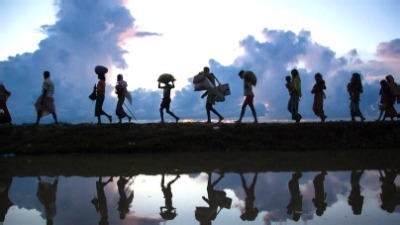
Image - © UNHCR/Roger Arnold
Nick Thompson, 04/09/2026