Who Shall Stand?
When Heaven Took Back the Nations 4
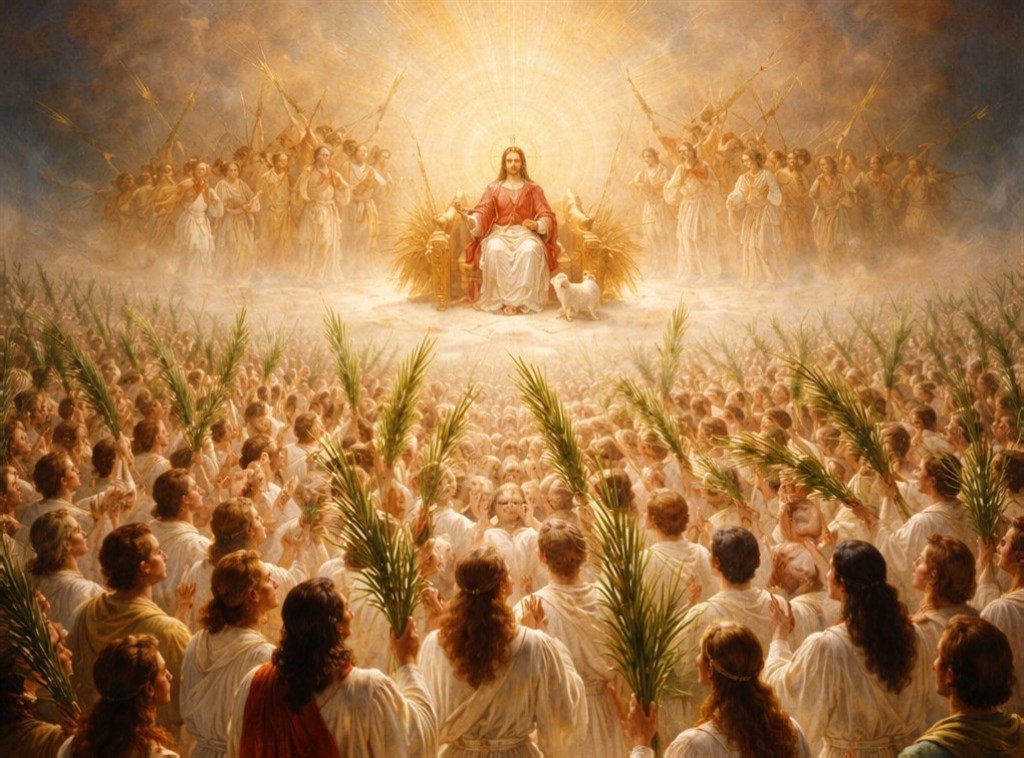 The Great Multitude Before the Throne
“After this I looked, and behold, a great multitude that no one could number…” (Rev 7:9)
There are chapters in Scripture that change the direction of a story. There are others that reveal the heart of the Author. Revelation 7 does both. Too often it is treated as though John has suddenly interrupted himself. The seals have been opened. Cosmic signs have shaken heaven and earth. Kings hide among the rocks, crying for the mountains to fall upon them. The terrifying question hangs unanswered in the air: “For the great day of His wrath has come, and who is able to stand?” (Rev 6:17).
Then, almost unexpectedly, John appears to change the subject. He speaks of angels restraining the winds. He speaks of the sealing of the 144,000. He then turns and beholds an innumerable multitude standing before God’s throne.
Many commentators describe this as a parenthesis. Yet I would suggest that it is far more satisfying to understand it as heaven’s answer to earth’s question. John is not interrupting the narrative; he is completing it. The chapter is the bridge between tribulation and wrath. It answers the cry of frightened humanity: who can stand? Those whom the Lamb has redeemed.
Before the Winds Blow
John begins: “After this I saw four angels standing at the four corners of the earth, holding back the four winds…” Rev (7:1). The phrase ‘after this’ translates the familiar Greek expression ‘meta tauta’ which John uses repeatedly throughout Revelation. Sometimes it marks a change of scene. Sometimes it signals progression within the vision. Either way, it invites the reader to move forward with John rather than backwards.
Now we see that the four angels restrain the winds. Throughout the Hebrew Scriptures, the winds frequently symbolise God’s instruments of judgment. Jeremiah speaks of scattering the nations with the four winds (Jer 49:36). Daniel’s four winds stir the sea before the emergence of the beastly empires (Dan 7:2). Zechariah speaks of the four spirits, or winds, going out from before the Lord of all the earth (Zech 6:5).
Before judgment falls, mercy completes its work.
Judgment is ready, yet it is restrained. Why? Because heaven is never hurried. God’s justice is never impulsive. Before judgment falls, mercy completes its work. That pattern stretches across Scripture. Noah entered the ark before the rain began. Lot departed Sodom before the fire fell. Israel sheltered beneath the blood before the destroying angel passed through Egypt. The pattern is not one of divine panic but of covenant faithfulness. The Judge remembers His promises before He executes His justice.
The Seal of the Living God
Another angel ascends from the east. He carries “...the seal of the living God”. The Greek word is ‘sphragis’. A seal in the ancient world signified ownership, authenticity and protection. Kings sealed decrees. Merchants sealed cargo. Owners sealed possessions. Paul uses the same language of believers: “Having believed, you were sealed with the promised Holy Spirit” (Eph 1:13). Again: “Do not grieve the Holy Spirit of God, by whom you were sealed for the day of redemption” (Eph 4:30).
The seal is not merely protection from danger; it is identification – that these belong to God. Long before Revelation, Ezekiel saw a remarkably similar vision. A man clothed in linen marked the foreheads of those who grieved over Jerusalem’s sin. Only afterwards did judgment begin (Ezek 9). John deliberately echoes that scene. The servants of God are identified before judgment proceeds.
The One Hundred and Forty-Four Thousand
John hears the number: 144,000. Twelve thousand from each tribe of Israel. Throughout Revelation there is an intriguing literary pattern. John hears one thing, then he turns and sees something that expands or interprets what he has heard. In Revelation 5 he hears of the Lion, turns and sees the Lamb. The two are not different individuals; they are complementary revelations of the same Messiah. Might something similar be happening here?
John hears the numbered servants of Israel. Then he looks and what does he see? A multitude beyond numbering.
John hears the numbered servants of Israel. Then he looks and what does he see? A multitude beyond numbering. This observation has led some scholars to suggest that the hearing and the seeing belong together, just as they did in chapter five. Others maintain they are two distinct groups. Whichever view one adopts, John’s emphasis remains unmistakable. God has not forgotten His covenant with Israel. Nor has He forgotten His promise to Abraham that through his seed all the nations would be blessed. Both truths stand together.
Paul reaches precisely this conclusion in Romans 9-11. God’s covenant purposes for Israel remain. At the same time, Gentiles are grafted into the olive tree through faith in Messiah Jesus. John’s vision beautifully reflects this covenant fullness.
A Multitude No One Could Number
As John moves towards describing the great multitude, once again the Greek is ‘meta tauta’: “After these things I looked, and behold…”. Again the vision moves forward. What he describes dwarfs every previous scene. People from every nation, every tribe, every people, every language. The language deliberately echoes Genesis. At Babel the nations were scattered, languages divided and humanity fractured. Now the curse begins to unwind.
The redeemed do not become culturally identical; they become united in worship.
We just have to read carefully. The nations have not disappeared; the languages remain as do ethnic identities. The Gospel does not abolish diversity; it redeems it. The redeemed do not become culturally identical; they become united in worship. This is the fulfilment of God’s promise to Abraham. It is the fulfilment of Isaiah’s vision that all nations would stream to the mountain of YHWH. It is the fulfilment of Zechariah’s prophecy that many peoples would seek the God of Israel. It is the fulfilment of Pentecost. What Babel divided, the Lamb unites.
Standing Before the Throne
John’s answer to Revelation 6 is beautifully simple. Who can stand? Those already standing. The Greek verb is ‘hestōtes’. They are not falling, not fleeing, not hiding among the rocks. They stand confidently before the throne. Why? Because they have already been justified by the blood of the Lamb.
In chapter six, kings cannot stand before God’s face. In chapter seven, redeemed sinners stand joyfully in God’s presence.
We can contrast the two scenes. In chapter six, kings cannot stand before God’s face. In chapter seven, redeemed sinners stand joyfully in God’s presence. Nothing about them has earned this privilege. Everything about Christ has secured it. Paul writes, “Therefore, since we have been justified by faith, we have peace with God” (Rom 5:1). The throne that terrifies the rebellious becomes the home of the redeemed.
White Robes and Palm Branches
The robes of the redeemed are white. Throughout Revelation, white garments signify purity, victory and covenant acceptance. They have washed them “...in the blood of the Lamb”. This is one of Scripture’s glorious paradoxes: blood stains; but the blood of Christ cleanses. Isaiah anticipated it: “Though your sins are like scarlet, they shall be as white as snow” (Isa 1:18).
John is quietly telling us that all the appointed feasts find their fulfilment in the Lamb: Passover; First fruits; Pentecost; Tabernacles.
Even more intriguing are the palm branches. The Greek word is ‘phoinix’. Palm branches immediately recall the Feast of Tabernacles, Sukkot. Leviticus 23 commands Israel to rejoice before YHWH with branches from beautiful trees, including palms. The feast celebrated God’s presence dwelling among His people during the wilderness journey. John’s imagery is therefore profoundly covenantal. The redeemed stand before God celebrating the final and eternal Tabernacles. The wilderness is over; the journey is complete; the true Promised Land has been reached. John is quietly telling us that all the appointed feasts find their fulfilment in the Lamb: Passover; First fruits; Pentecost; Tabernacles. Every feast points towards Christ.
They Have Come Out
One of the elders explains, “These are they who have come out of the great tribulation.” The Greek reads ‘hoi erchomenoi’, which means, literally, ‘The ones who are coming out’. The participle is present in form, conveying an ongoing emergence. The picture is of a continual stream of redeemed people arriving before the throne. This is not merely one generation. It is the completed people of God – every believer, every martyr, every faithful disciple – gathered into one worshipping assembly.
The expression translated great tribulation is ‘tēs thlipseōs tēs megalēs’ (which reads literally, ‘the tribulation, the great’). The wording is significant here. It is not ‘orgē’, wrath, but ‘thlipsis’, affliction. It is pressure, persecution. John carefully preserves the distinction. They have come through tribulation. The wrath is still about to unfold.
The Shepherd Upon the Throne
Perhaps the most beautiful verses in the chapter come last: the Lamb becomes Shepherd. John deliberately combines Psalm 23 with Isaiah 49: “The Lamb in the midst of the throne shall shepherd them…” The Greek verb is ‘poimanei’. It means to shepherd, guide, pasture and protect. The Lamb is simultaneously Sacrifice, King and Shepherd. Only Jesus can unite all three offices.
It is illustrative that He stands “in the midst of the throne” – exactly where He stood in chapter five. The Shepherd is YHWH. Ezekiel had prophesied, “I, Myself will shepherd My sheep” (Ezek 34:15). Then, only a few verses later, “I will set over them one Shepherd, My servant David” (Eze 34:23). What appeared to be two promises becomes one Person; Jesus fulfils both. He is David’s Son; He is Israel’s Shepherd; He is YHWH dwelling among His flock. The Divine Council has recognised His authority. Now the redeemed experiences His everlasting care.
The Answer Before the Judgment
Revelation 7 is not merely a comforting interlude. It is a theological necessity. God answers the question before He proceeds with judgment.
God answers the question before He proceeds with judgment.
Who can stand? Those clothed in Christ.
Who survives the Day of the Lord? Those sealed by the living God.
Who inherits the nations? Those redeemed by the Lamb.
This chapter is the calm before the trumpets. The redeemed are safely before the throne. The covenant people, Jew and Gentile together in God’s redemptive purpose, have been identified. The Shepherd has gathered His flock. Only now is heaven ready to fall silent. Only now can the prayers of the saints ascend like incense. Only now does the Day of the Lord move from announcement to execution. The Lamb has gathered His people. The Judge is about to answer their prayers.
Nick Thompson
You can read the first three parts of this series here: Revealing the Lamb; The Lamb Receives the Kingdom; The Opening of the Seals
Image from Bible Art
Nick Thompson, 15/10/2026