Charles Gardner reviews ‘The New Dark Ages: The End of Reading and the Dawn of a Post-Literate Society’ by James Marriot (2026)
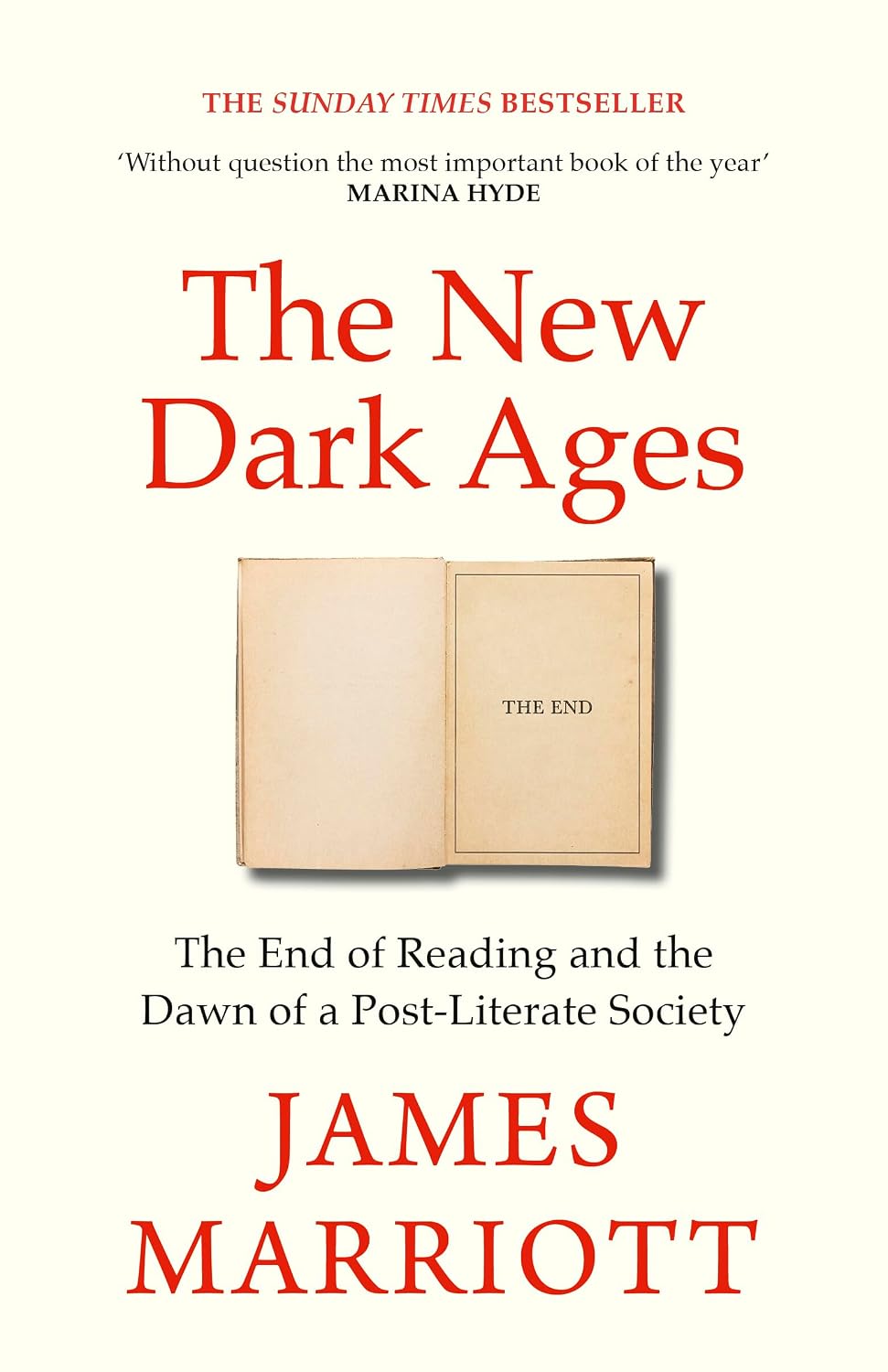 Six hundred years after the invention of the printed book, it has never been more threatened or more irreplaceable.
This is the stark and sobering conclusion of the author of this study, a columnist at The Times, who also presented the Radio 4 series How Reading Made Us, about the history of literacy.
Smartphone era
James Marriott makes use of substantial evidence to back his claim that the ‘smartphone era’ has robbed people of the ability to think coherently, reducing their already meagre ‘knowledge’ to a hotch-potch of sloppy slogans.
He is clear that the change in reading habits from the printed page to social media is taking us back to the Dark Ages. His deeply stirring new book demonstrates how it is undermining democracy and dumbing down public debate to monosyllabic drivel.
People, he maintains, are no longer reading books and newspapers and, as a result, have lost the ability to comprehend and communicate ideas. We are no longer influenced by what we read, but by the latest message on our mobile which serves to distract and even enslave us on an almost permanent basis.
And our addiction renders us incapable of grasping what is going on in the world, which helps explain the mass signing up to protests over issues about which we know virtually nothing.
James alludes to this in his study, decrying the way screen-based communication (which includes YouTube, Instagram and TikTok) excites the viewer “even if you don’t really have much of a clue what is actually going on in the Middle East”.
Wonderous merits of literature
It is important to note that the author isn’t hectoring or judgmental. He fully recognises the essential role that mobile phones play in our lives, as well as the significance of social media. To decry them would be like lamenting the invention of aeroplanes or the internet. In distinction, the author’s focus is primarily on advocating a return to the wondrous merits of literature.
People, he maintains, are no longer reading books and newspapers and, as a result, have lost the ability to comprehend and communicate ideas.
I thoroughly concur with his overall thesis, and, as I told him myself at the book’s launch in York, Christians too have tragically stopped reading books and newspapers, and are thus highly vulnerable to social media slop, backed up by news flashes from the broadcasters. They no longer allow themselves to be informed by clear-headed written script on the threats to our country and faith.
In answer to my point, he declared his ‘not religious’ credentials, but I have since spotted references to Christianity, mostly positive, all over the book.
Of course, the part played by the Bible in encouraging people to read since the invention of the printing press is fully acknowledged, and he owns up to being put in his place after challenging a street preacher as a teenager influenced by the ‘new atheism’.
Renewing our minds
James is obviously still sceptical of the supernatural but betrays a hint of seeking something deeper with his repeated references to the ‘meaning of life’. Yes, he seems to say this is something attainable, to some degree, through books – in contrast to the meaningless addiction to smartphones. According to one estimate, users check their mobiles on average 144 times a day!
I personally believe that the abuse of smartphones are partly to blame for the exponential rise of antisemitism across the world.
But Christians also need to read more, and more diversely, so that they’re less inclined to be influenced by short, sharp, machine-gun messages from broadcasters with an agenda (while always remembering that authors of books and newspapers have an agenda too). I personally believe that the abuse of smartphones are partly to blame for the exponential rise of antisemitism across the world.
Believers should instead be renewing their minds as the Apostle Paul urges in the context of understanding our responsibility to Israel (Rom 12:2). This of course involves reading the Bible (Old and New Testament) as well as good books on diverse themes that aid our understanding.
Medium of rational persuasion
James recalls how reading was virtually his family’s religion. “Shakespeare was our Jesus…”, he writes. But he freely admits that literacy “cannot effect a wholesale reformation of human nature”.
James is appalled, as we all should be, by the “nihilistic tornado of content” on TikTok, adding that “the smartphone is to information what fast food is to nutrition” and that, for many, “reality is an increasingly marginal phenomenon that occurs around the edges of screen time”.
As a journalist whose career was steeped in newspapers – and I still write for some – it pains me to record the fact that Britain saw 320 newspapers close between 2009 and 2019.
It pains me to record the fact that Britain saw 320 newspapers close between 2009 and 2019.
As a result, growing numbers of citizens are oblivious to current affairs. According to one estimate, there may now be fewer local newspapers in the UK than at any time since the 18th century – i.e. since before the birth of modern democracy. One ominous result is that citizens vote less!
The life that is truly life
James adds that “where print can be used as a medium of rational persuasion and for the cultivation of sympathy, screens tend to push us towards conflict”.
As to the meaning of life clearly on Marriott’s mind, the Jesus he substituted for books is the very one who epitomises life itself. For he said: “I am the way, and the truth, and the life; no-one comes to the Father except through me.” (John 14:6)
And in the words of St Paul, knowing Jesus is to take hold of “the life that is truly life” (1 Tim 6:19).
Charles Gardner (with Tom Lennie)
Charles Gardner (with Tom Lennie), 16/10/2026