When Delay Quietly Changes Our Priorities
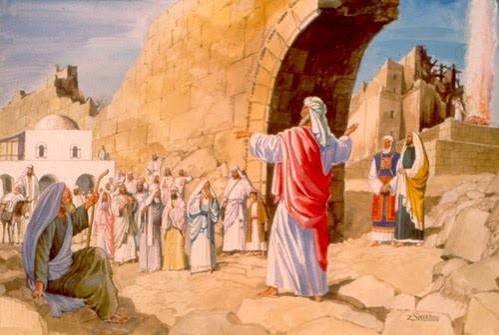 I've found myself thinking about Haggai 1 and Ezra 6 together recently, because when you read the story across both books, something begins to emerge that I think is very easy to miss. The people of Judah had returned from exile with a clear purpose, the rebuilding of the temple had begun and its foundations had been laid, yet somewhere between that beginning and the eventual completion of the work, years passed in which the house of God remained unfinished.
What caught my attention wasn't simply that the work had stopped, but how life had carried on around it.
The people built homes, planted crops, earned money and gradually established themselves again in the land, which after everything they had lived through probably felt entirely reasonable. They had experienced exile, displacement and loss, and now they were finally rebuilding some kind of normality for themselves. Yet while their own lives were being rebuilt, the temple remained unfinished, and by the time Haggai begins to speak, the people are saying, “The time has not yet come to rebuild the LORD's house.”
Unfinished obedience
There is something about that sentence that has really stayed with me because they haven't rejected God, nor are they saying that His house doesn't matter. They still believe it should be rebuilt at some point; they have simply concluded that now isn't the time.
... by the time Haggai begins to speak, the people are saying, “The time has not yet come to rebuild the LORD's house.”
I wonder whether that is sometimes how unfinished obedience begins to settle into our lives. Very few of us would consciously decide that something God has asked of us no longer matters, but when something becomes difficult, opposition comes or far more time passes than we expected, it is surprisingly easy for “not yet” to become our normal. Other things understandably require our attention, life fills the space around what has been delayed and eventually we can become quite comfortable living alongside something that once felt incredibly important.
That seems to be what God begins to uncover through Haggai when He asks, “Is it a time for you yourselves to be living in your panelled houses, while this house remains a ruin?”
I don't read that as God objecting to His people having homes or rebuilding their lives after exile. They needed somewhere to live, families needed providing for and ordinary life still had to continue, but there seems to have been a subtle reordering of priorities. Somehow, while waiting for the right time to finish what belonged to God, they had found the time and energy to establish what belonged to themselves.
That made me stop because I think delay can do something to us if we aren't careful. Something God placed on our heart can begin with real clarity, but when the road towards it becomes difficult, when circumstances don't seem to cooperate or when nothing appears to move for a long time, we can gradually reinterpret the delay. What began as something we were waiting to continue can quietly become something we assume God must no longer be asking of us, not necessarily because He has said anything different, but because continuing would require something from us that settling where we are does not.
Giving careful thought
Perhaps that is why one phrase appears repeatedly through Haggai 1: “Give careful thought to your ways.”
What began as something we were waiting to continue can quietly become something we assume God must no longer be asking of us ...
I really love the way God says that because He is asking them to look honestly at what has been happening in their lives. They have planted much but harvested little, they eat without being satisfied, drink without being filled, put on clothes without becoming warm and earn wages only to put them into what Haggai describes as a purse with holes in it. There is enormous effort being expended, yet very little seems to be producing what they expected.
God is drawing their attention to the connection between what they have been experiencing and what they have neglected, and in their particular circumstances He makes that connection unmistakably clear.
I think there is something quite searching in that because Scripture certainly doesn't teach us that every difficult season, financial pressure or lack of progress means we have somehow disobeyed God. Some of the hardest seasons in Scripture happen precisely because people are being obedient. So Haggai can never become a formula for looking at difficulty and assuming we must have done something wrong. Yet there are moments when the Holy Spirit does invite us to look more closely at the patterns in our lives and ask whether something has shifted without us really noticing.
Perhaps sometimes the question isn't simply why something feels so difficult, but whether the things receiving the greatest part of our energy are still the things God has asked us to prioritise.
The Lord’s stirring
What I find particularly encouraging is what happens when the people respond, because once their priorities have been exposed, God doesn't leave them there. Haggai tells us that Zerubbabel, Joshua and the remnant obeyed the voice of the Lord, and then God sends another message through His prophet:
“I am with you.”
I've found myself sitting with the order of that. The temple is still unfinished, the lost years haven't been recovered and there is still a huge amount of work ahead of them, yet God assures them of His presence before the rebuilding gets underway again.
Then Haggai tells us that the Lord “stirred up the spirit” of Zerubbabel, Joshua and the whole remnant of the people, and they came and began work on the house of the Lord.
God awakens something in them again.
There is something very encouraging in that because their renewed obedience doesn't seem to come simply from somebody making them feel sufficiently guilty about what they haven't done. God awakens something in them again. The people who had lived for years with an unfinished temple begin building because the Lord stirs their spirits, and that has made me think about the things we can assume are simply too far gone because we have neglected them for too long.
Sometimes we know we have drifted from something God once made clear, but after enough time has passed it can feel almost harder to return than to keep going as we are. We see the years that have been lost, remember the enthusiasm we once had and perhaps assume that if God really wanted to use us in that thing, we wouldn't have allowed it to become so neglected in the first place. Yet Haggai shows a God who is perfectly capable of stirring His people again, even after years of delay.
And when we turn to Ezra, we discover that this stirring of the people was only part of what God was doing.
The work questioned
Ezra 5 tells us that Haggai and Zechariah began prophesying to the Jews in Judah and Jerusalem, and that Zerubbabel and Joshua responded by setting to work on rebuilding the house of God. It is the same moment we have just been reading about in Haggai, but Ezra allows us to see what happened around them as they obeyed.
I think that connection matters because it means Ezra 6 isn't simply a later account of God providing for a building project. It is the continuation of what began when God's word confronted His people, their spirits were stirred and they returned to the work they had left unfinished.
And almost immediately, the rebuilding attracts attention. Tattenai, the governor of the province Beyond the River, and his associates arrive and begin questioning who has authorised the work. They ask for the names of those responsible and send a report to King Darius, which must have felt horribly familiar after everything that had happened before.
They were being questioned, but the work continued.
I found myself wondering what it must have felt like to be one of the people rebuilding at that point. You have finally responded to God, picked the work back up and begun again, only for the circumstances that frightened you the first time to start appearing all over again. I think I would have been tempted to wonder whether the renewed opposition was evidence that I had misunderstood God.
But Ezra includes a detail that I hadn't really appreciated before.
“But the eye of their God was watching over the elders of the Jews, and they were not stopped until a report could go to Darius and his written reply be received.”
They were being questioned, but the work continued.
And I think that is important because the people were not being asked to wait until every possible objection had been resolved before they could obey. They had heard God's word through the prophets, they had returned to the building and, while the Persian authorities investigated, God's eye was upon them.
Obeying first
Then, in Ezra 6, a search is made through the royal archives and Cyrus's original decree is found, confirming that the rebuilding had been authorised. Darius goes further than simply allowing the work to continue; he commands the officials not to interfere and orders that the costs of rebuilding should be paid from the royal revenues.
Darius commands the officials not to interfere and orders that the costs of rebuilding should be paid from the royal revenues.
The investigation that might have seemed so threatening ends with the work being protected and provided for.
What I find remarkable is that none of this was visible to the people when Haggai first called them to consider their ways. They couldn't have known how Darius would respond, where the money would come from or how the political questions would be resolved. They simply knew that God had spoken, and as they began doing what He had asked, events were unfolding far beyond anything they could have arranged for themselves.
I've found myself reflecting on how much time I can spend trying to work out how God is going to make everything possible before I am willing to take the next step. I want to understand where the provision will come from, how the obstacle will move and what will happen if somebody says no, when perhaps none of those things were mine to resolve before obeying.
The people in Ezra couldn't issue royal decrees, control Persian officials or release money from the king's treasury. What they could do was return to the building, and I wonder how often we become so occupied with everything that appears to stand in the way that we lose sight of what God has actually placed in our hands.
There is something freeing in recognising that difference, because obedience doesn't require us to become responsible for everything that obedience will eventually involve. It asks us to be faithful with what God has placed before us while trusting Him with the circumstances that remain beyond our reach.
The glory will be greater
And Ezra makes it clear that God's work wasn't confined to what was happening in Jerusalem. The same God who had stirred the spirits of His people was at work through the decisions of Persian kings, bringing about the completion of something that had seemed impossible for so long.
Obedience ... asks us to be faithful with what God has placed before us while trusting Him with the circumstances that remain beyond our reach.
By the end of Ezra 6, the temple is finished, and the writer makes a point of telling us that the elders prospered through the preaching of Haggai and Zechariah. That detail has stayed with me because it brings us right back to where the rebuilding began. God's word had exposed what was wrong, stirred His people to respond and continued to sustain them as they worked, while His providence opened the way for the temple to be completed.
There is something else about that completion that I find quite moving, particularly when we remember what Haggai says later about the people who had seen Solomon's temple.
Some of the older generation remembered what had stood there before the exile, and the new temple seemed small by comparison. Haggai asks them, “Who of you is left who saw this house in its former glory? How does it look to you now?” before God tells them to be strong and continue working because He is with them.
Then comes the promise that “the glory of this present house will be greater than the glory of the former house.”
I wonder what they understood by that as they looked at the building taking shape in front of them. They knew what had been lost, and perhaps some of them couldn't help comparing what they were rebuilding with the glory of what had once stood there. Yet God was speaking about something much greater than the appearance of the temple.
Reading Haggai and Ezra with the rest of Scripture in view makes that promise even more significant, because the temple was always about more than a building.
His presence
From Eden onwards, we see God's desire to dwell among His people. The tabernacle in the wilderness and later the temple in Jerusalem were places associated with His holy presence, and the loss of the temple at the exile was bound up with the terrible consequences of Israel's covenant unfaithfulness.
Christ opens the way for something greater still, and when the Holy Spirit is poured out at Pentecost, the people of God themselves become His dwelling place.
So when God calls His people to rebuild, He is restoring far more than the physical centre of their worship. He is drawing them back into the life of a people set apart for Himself, with His presence at the centre of everything.
And yet even that restored temple could only point forward.
When John tells us that “the Word became flesh and made his dwelling among us,” the language takes us back to the tabernacle and God's presence with Israel. In Jesus, God has come among His people in a way no building could ever contain, and when Jesus speaks of destroying the temple and raising it again in three days, John tells us that He was speaking about His body.
Through His death and resurrection, Christ opens the way for something greater still, and when the Holy Spirit is poured out at Pentecost, the people of God themselves become His dwelling place. Paul writes that we are God's temple and that His Spirit dwells among us, while Peter describes believers as living stones being built into a spiritual house.
The more I follow that thread, the more extraordinary Haggai's words become, because the God who told His people “I am with you” would ultimately come to dwell among us in Christ and, through His Spirit, make His home within His people.
A comfortable substitute
It also makes me think differently about what we are building now.
We aren't being called to rebuild a physical temple in Jerusalem, and I don't think we can simply take every detail of Haggai and apply it directly to our own ambitions or unfinished plans. But the question of what occupies the centre of our lives hasn't gone away, and perhaps that is where these chapters begin to speak so personally.
... good intentions can sometimes become a comfortable substitute for actually responding.
I wonder whether it is possible to become so busy with the lives God has given us, the responsibilities we carry and even the blessings we have prayed for that we gradually allow our relationship with Him, our obedience to His word and the things He has called us to prioritise to move further and further into the background.
We may still love Him, still believe His word and still intend to return to what He has placed on our hearts, but Haggai makes me wonder whether good intentions can sometimes become a comfortable substitute for actually responding.
Of course, there are things God genuinely closes, plans He redirects and seasons that come to an end. Discerning those moments requires prayer, wisdom and the leading of the Holy Spirit. I don't think faithfulness means continually returning to everything we once hoped to do, but I do wonder whether there are things we have learned to call timing or circumstance when, if we allowed God to search our hearts, we might discover that disappointment, fear or simply the comfort of where we are has played a greater part than we realised.
Perhaps that is why “Give careful thought to your ways” has stayed with me so much. It invites us to look honestly at what has happened to our priorities, particularly during the seasons when life hasn't unfolded as we expected, and to ask whether something God once made clear has quietly become something we no longer feel any urgency to obey.
I am with you
But what encourages me most is that Haggai and Ezra don't leave us with the weight of everything we have failed to do.
The people had allowed years to pass, yet when they listened to God's word and responded, He stirred their spirits again. As they returned to the work, He watched over them, sustained them through the prophets and brought about provision through people and circumstances they could never have controlled.
What matters is that we hear Him and are willing to follow, allowing the Holy Spirit to search what has shifted in us ...
And I think that is what I want to hold onto from these chapters, because there may be things in our lives that have been delayed for so long that we have begun to assume they will never happen, or things we have quietly laid aside because the opposition took more out of us than we expected. Yet if God is stirring us to return to something He has asked of us, we don't need to have every question answered or every obstacle removed before we begin responding.
What matters is that we hear Him and are willing to follow, allowing the Holy Spirit to search what has shifted in us and trusting that the God who was at work in Jerusalem was also at work in the courts of Persia.
I find that deeply reassuring, because the people in Haggai's day could only see the work in front of them, while God could see everything that would be needed to bring it to completion. Perhaps there are times when we become so discouraged by what remains unfinished that we forget how much of God's work has always taken place beyond what we can see, and how often He begins by drawing our hearts back to Himself before showing us what He has already been preparing.
The invitation to give careful thought to our ways is still worth taking seriously, but so is the promise that met the people when they turned back towards Him: “I am with you.”
And perhaps that is where renewed obedience begins, not with confidence that we have finally worked out how everything will happen, but with the assurance that the One calling us to respond is already present, already at work and still able to accomplish far more than we can see from where we are standing.
Hannah Damary-Thompson
(image c/o https://jamesjackson.blog/)
Hannah Damary-Thompson, 06/11/2026