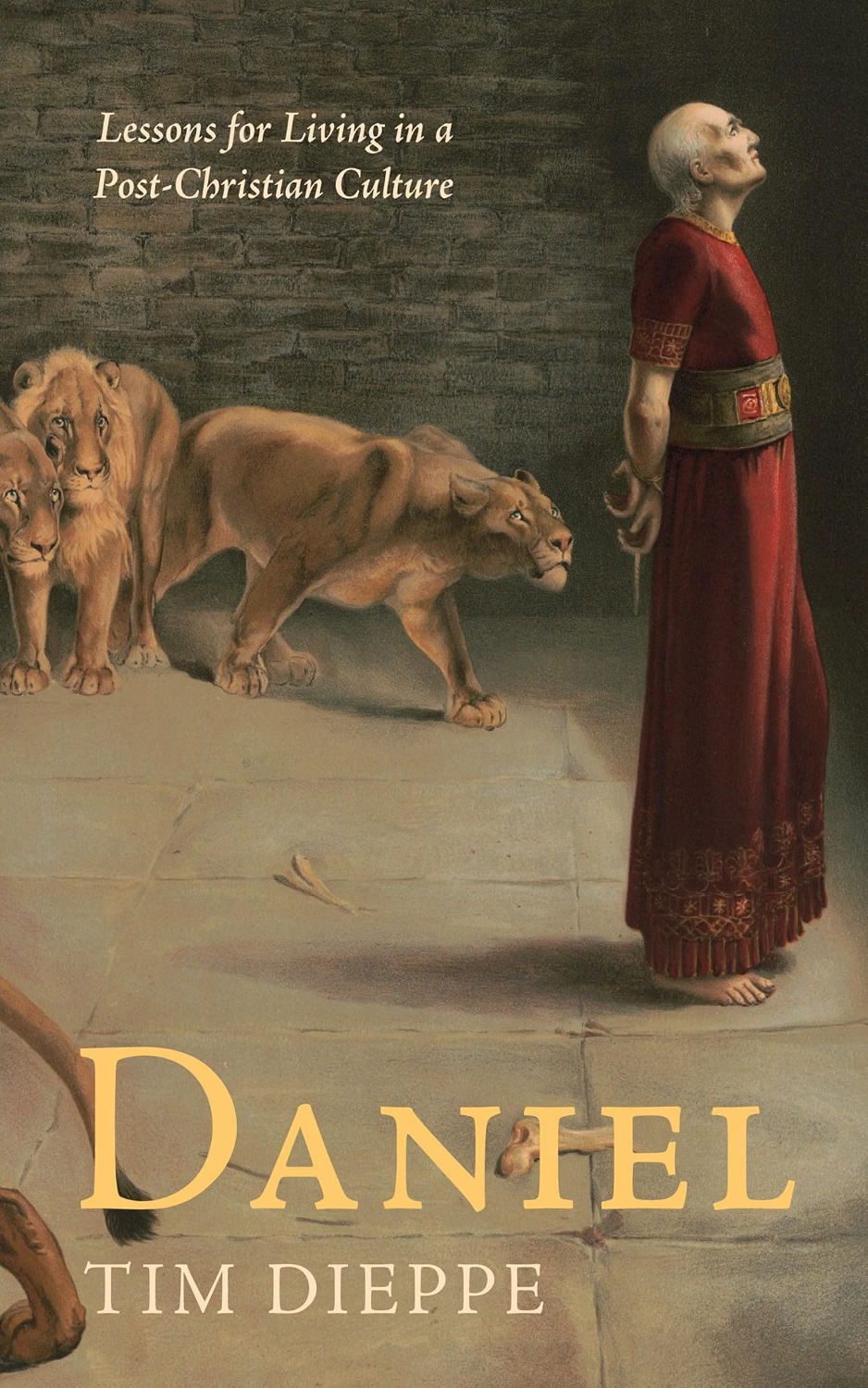
Tom Lennie reviews ‘Daniel: Lessons for Living in a Post-Christian Culture’, by Tim Dieppe (2026)
 Introduction
Many readers will know of Tim Dieppe for his seminal work at Christian Concern, where he serves as Head of Public Policy, constantly campaigning vigorously on matters of faith, law and public policy.
As such, he regularly appears on UK television shows (GB News, Revelation TV, etc), and on radio stations and podcasts (such as Premier Radio, LBC and BBC Radio). You’ll also find him writing regular opinion columns and commentary for the likes of Premier Christianity, The Critic, and national media.
He’s known as an authority on the challenge of Islam in the West and last year wrote a significant study on that theme, urging Christians and policymakers to counter multiculturalism with open debate and active evangelism. Clearly, a busy guy, then. How he found the time, among all his other work, to research and write this detailed, scholarly 300-page study on an Old Testament prophet is frankly beyond me.
Relevance
He did so, he tells us, because he is convinced that Christians living in a post-Christian culture – as Western believers now do – have so much to learn from this ancient man of faith, who bore a life of faithful witness amidst a thoroughly pagan culture. Tim sees the book of Daniel as a call to Christians everywhere to be strengthened in our faith, to imbibe courage to face the struggles and pressures of this age and to trust completely in God’s sovereignty, even if, like Daniel, we don’t always comprehend what God is doing.
“Daniel passed all the tests that the end-time Church will face”, Tim states. “His life is a picture of how the Church can overcome evil and suffering in this age.” (p.xvii). Hence, the sub-title of the book.
It has been observed that the twelve chapters of Daniel have been “dissected and denied” more than perhaps any Old Testament prophetic book. Every liberal, and even several evangelical theologians – notably Michael Heisler – have disputed the reality of a historical Daniel. Tim counters these interpretations with a well-argued defence of the historical authenticity of Dan the man - a premise that underlies the entire study.
Tim sees the book of Daniel as a call to Christians everywhere to be strengthened in our faith, to imbibe courage to face the struggles and pressures of this age and to trust completely in God’s sovereignty ...
Chapter and verse
Thoroughly aware that Daniel paid close attention to chronology, the author examines the biblical book chapter by chapter, from Daniel 1: Taken to Babylon for Indoctrination right through to Daniel 11: The Kings of the South and the North, and 12: The Time of the End.
Tim provides a historical setting for each chapter, accompanied by some detailed analysis. He proceeds with a Comments section, which acts as a fascinating in-depth verse-by-verse Bible study. This in turn is followed by an Application, where the author shows the relevance of the biblical text for followers of Jesus today.
A poignant illustration of such applicability appears in Chapter 5: The Writing on the Wall. Daniel interprets the mysterious message that appears as a divine judgment announcing that God has numbered Belshazzar’s days and found him morally wanting. Tim observes a remarkable parallel to this confrontation of a ruler with impending judgement in a modern-day story from Nigeria, related by Clifford and Monica Hill in their testimony book, ‘Seeing the Hand of God’. You’ll have to read that worthy volume, or else this one, to see that striking real-life story unfold, but Tim uses it to demonstrate just how in control God is – and always has been – of rulers and nations and their destinies.
Tim regularly quotes from the early Church fathers – men like Jerome, Josephus, Eusebius and Irenaeus.
Throughout his study, Tim regularly quotes from the early Church fathers – men like Jerome, Josephus, Eusebius and Irenaeus. He believes such figures often have more insight into the Scriptures than many modern commentators. But he takes the latter seriously, too, repeatedly referencing Aubrey E. Buster, Steven Anderson, Paul Tanner, et all, as he also does the writings of sixteenth century French theologian John Calvin, among others.
Summary
Several ‘Excursus’ explore themes such as the authenticity of Darius the Mede, the ‘son of man’ figure of Daniel 7, and the dating of Artaxerxes’s reign. Timelines, charts and illustrations make helpful sporadic appearance, and a lengthy bibliography and index are included at the close.
‘Daniel: Lessons for Living in a Post-Christian Culture’ is a rich, thought-provoking, and eminently readable study – well worthy of any serious Christian’s attention. The reader's knowledge of biblical history and scholarship can only benefit as a result.
For the above reasons, I heartily recommend this weighty tome.
‘Daniel: Lessons for Living in a Post-Christian Culture’ (325pp) is published by Wipf and Stock and is available from Amazon for £31.61 (£8.86 on kindle). You can get it half price from here until Mon 30th November, using discount code CONFSHIP at checkout.
Tom Lennie, 26/11/2026